Monday, May 16, 2011

Lahore: National College of Arts


On the famous The Mall of Lahore, Opposite (south) of Kim's Gun and framed by the foliage of enormous trees is one of the most important institutions that the Punjab has to offer—the National College of Arts or NCA, rated by some as the finest art institution in Pakistan.

The art school was named Mayo School of Industrial Art, since the cost of its construction was met by subscriptions to the Mayo Memorial in memory of Viceroy Lord Mayo (1869-72), who was stabbed to death by a prisoner in the Andaman Islands.

The school was established as part of the policy of the Government to promote education in arts and crafts in the subcontinent, the first art schools having been established in the presidency capitals of Calcutta, Madras and Bombay. Lockwood Kipling, father of the famous author Rudyard, had taught architectural sculpture at Bombay School of Art for ten years before arriving as principal of the Lahore School in April 1875. Kipling, considered the father of Indian arts and crafts, was followed by Bhai Ram Singh, another eminent personality.

The flooding of the Punjab market with British manufactures from Manchester drove the local industry out of business by the turn of the century. Popular taste was weaned from its cultural roots, which resulted directly in the decline of art and craft. Nearly 40,000 cotton workers and 900 weavers in Lahore were rendered jobless. Cotton printing being done in the city and once prized in such far-off places as Switzerland and Holland, was badly hit by the shoddy machine-made variants that came in from Manchester. Cottage industry in woolen and silk doth was virtually wiped out. The Mayo School became a haven for representative professionals from all the industries thus affected. European designs in building and furniture and the rise of the furniture firms brought bad times for the Punjabi carpenter reputed one of the cleverest in the world. The vogue received by photography and printing produced a great demand for lithographers and the school set up a process department for the production of line, half tone and color blocks for illustrating purposes.

The original courses followed the general art curriculum of European art schools with the inclusion of examples of oriental architecture, and 'principles of the Indian design'. Within a decade the school earned a well-deserved reputation for the promotion and training of local craft persons. In the Gazetteer of 1884 Kipling noted, "The Mayo School has had a decided influence on the carpentry as well as on other branches of manufacture, such as cotton prints, metal work etc. This is partly due to objects actually made in the school, to designs and suggestions given to bazaar craftsmen, and to its connection with exhibitions held in Paris, Melbourne, Lahore and Calcutta, for which it has acted as an agent. Its aim is to recur as much as possible to the best types of indigenous design, and to make more widely known the actual state and capabilities of the arts of the province."

The foundation stone of the Kipling Block (now the administration block) was laid on January 3,1880 by Prince Albert Victor, and presents an early example of the utilization of Mughal imagery. Referred to as 'late Mughal' style in contemporary accounts, its construction was supervised by a famous engineer of Lahore, Khan Bahadur Ganga Ram, who later became well known for his philanthropy. Initially, the building consisted of six rooms. Temporary additions were made to it in 1881 to house an exhibition of the Punjab Crafts. In 1891, these temporary structures were made permanent in accordance with a design prepared by the Principal. Now the school had proper workshops equipped with tools and machines. In 1902 four large machine workshops and photolithographic studio were already functioning. The fountain in the front of the main entrance was designed by Sirdar Bahadur Bhai Ram Singh, much admired as a designer and craftsman when selected to decorate a section of Queen Victoria's Osborne House. Kipling utilized his crafts and sculpture background to construct a comparatively simple but elegantly detailed structure. The beautifully laid brick masonry of the walls is terminated at the roof with an outer cornice of red sand- stone, which, historian Latif informs, had been obtained from Delhi.

By 1911, nearly a lakh of rupees worth of machinery and tools were being operated in the school for such diverse crafts as jewellery, cotton-printing, book-binding, cabinet making, light-metal work, carpentry and blacksmithy. By 1915, the work done at the school was recognized all over India and also in England. The principal works executed by its craftsmen were thus located: Wood-carving, plaster-work and interior in Barnes Court, Simla; Government House, Lahore; Circuit House, designs for amphitheatre at the Delhi Durbar; execution of decorative work including carpets and shamianas of gold thread and repusse metal work and designs for the Law and Oriental Colleges, Lahore; design and decorative work in plaster for the new Railway Theatre, Lahore; a carved console table for Government House, Lahore; Punjab carving for the Billiard Room of Bagshot Park, England for the Duke of Connaught; an eight canon stall for the Lefroy Memorial in Lahore Cantonment’s Church.

If you wish to experience a magical world, you will need to enter the lofty aiwan-like Mughal portal of the college. Worth the experience are the administration block, Zahoorul Akhlaq Gallery, (named after one of the most brilliant sons of the college), the printmaking studio, workshops and the architectural block. Some of the early works of architect Nayyar Ali Dada, another famous alumnus of the college, are also located in the campus and are worth visiting
Kim's Gun

The interlinked spaces of the college create a world of their own, a world of charm and creativity, as if Kipling had achieved his goal of insulating the creative urges of the future artists from the harsh reality of the outer world. The ambiance of the internal courts with their red brick arched facades transports you to a bygone era, hard to replicate anywhere else.

Text: ualbterta
Photos: Shiraz Hassan


Saturday, May 14, 2011

Lahore's Heritage: Punjab University [Old Campus]


Another one of the fine educational institutions that Lahore seems to abound in is the old campus of Punjab University, located opposite to the Lahore Museum building across the Upper Mall Road.

Lahore Government College, established in 1863, was followed by several other educational institutions of higher learning such as Oriental College (1865) and Forman Christian College in 1866. However, they were all affiliated with Calcutta University. Historian Latif credits the efforts of people of the province in the creation of Punjab University, which was the "result of their desire for a living and growing system of education, in the control and direction of which they may have a share and which will blend with the ancient learning of the country, and make use of its classical and vernacular languages as the media of instruction."

The University began its life as "the Lahore University College" and in 1869 came to be called "the Punjab University College." The University was formally constituted on 14 October 1882, and Charles Aitchison, Lieut. Governor of the Punjab, appointed the first chancellor of the university. Contrary to the three previously established universities, which were only examining institutions, the University of the Punjab was both teaching as well as examining body right from the beginning. By 1910, 10 colleges had become affiliated to the university, many of which were located in its close vicinity. The contribution of Dr. G. W. Leitner, an enlightened Hungarian and a naturalized Britisher, was instrumental in the establishment of this University and became its first Registrar.

To view the Anglo-Mughal style Punjab University Hall, designed by Bhai Ram Singh, you will need to enter the gate which is directly opposite Lahore Museum. Although not as majestic as Kipling's Anglo-Mughal museum, Punjab University Hall is nevertheless an impressive structure. Belonging to late-Anglo-Mughal style—its foundation stone was laid in 1905—the building boasts lancet arches and a profusion of cupolas in varying sizes. The two-storey building, now housing the university's fine arts department, is designed in the manner of Raj buildings, incorporating a deep arcaded verandah front. A heavy-set clock tower, placed above the projecting porch or deorhi, dominates the centre as it rises well above the main structure and corner towers.


The square portion of the tower displays large clocks on its four sides, while its last stage is composed of an octagonal clifton'-like structure capped by a dome terminated with a finial. The emphasis on the outer extremities of the building is provided by corner towers, which carry similar domes. Each bay of the verandah is also defined by decorative columns terminating above the parapet in the form of towers capped by small cupolas. Its reddish-pink hue, though not as mellow as the buildings across the road, blends well with the surrounding environment. Another building, of later vintage but of similar Anglo-Mughal characteristics, now houses the pharmacy department.

Placed between the two imposing structures, but slightly set back is a small, two-storey structure built as the Punjab University Union Society, begun in 1933 to mark the jubilee celebrations of the university. The building is now known as Woolner Hall, named after a dedicated teacher of the university, who rose from the position of registrar to being its vice-chancellor. This is the same Alfred C. Woolner, whose enormous bronze statue on a granite base adorns the pavement outside the university campus.


Due to the pressure of the rising number of students and affiliated colleges, during the 1960s the university, except for a handful of departments, was shifted to a new campus, spread over 10 square miles, on a picturesque canal bank site south of the city.

Text: ualberta.ca
Photos: Shiraz Hassan


Wednesday, May 11, 2011

لاہور کا تعلیمی ورثہ.... گورنمنٹ کالج یونیورسٹی


لاہور کا تعلیمی ورثہ.... گورنمنٹ کالج یونیورسٹی

برصغیر کی تاریخی اہمیت کی حامل قدیم درس گاہ


لاہور کی مال روڈ انگریز عہد میں تعمیر ہونے والی عمارتوں کا دلکش منظر پیش کرتی ہے۔ ٹھنڈی سڑک کے نام سے معروف یہ شاہراہ انگریز دور میں برطانوی سرکار کی مرکز نگاہ رہی اور یہیں کئی اہم عمارتوں کی تعمیر عمل میں لائی گئی۔مال روڈ کے آخری حصہ جہاں ناصر باغ ہے، اس کے دوسری جانب آپ کو ایک بلند و بالا کلاک ٹاور دکھائی دے گا۔ جو وہاں سے گزرنے والوں کو اپنی جانب نگاہ دوڑانے پر مجبور کر دیتا ہے۔ یہ بلندو بالا شاندار کلاک ٹاور برصغیر کی تاریخی اہمیت کی حامل درس گاہ گورنمنٹ کالج یونیورسٹی کا ہے۔

گورنمنٹ کالج یونیورسٹی نے ایک صدی سے زائد کی تاریخ اپنے سینے میں سمو رکھی ہے۔ اس تاریخی دانشگاہ کا شمار خطے کی کی بہترین درس گاہوں میں کیا ہے اور آج اس تاریخی درسگاہ سے وابستہ ہونے کی خواہش ہر طالب علم کے دل میں پائی جاتی ہے۔ اپنی لازوال تاریخی و تعلیمی اہمیت کی بدولت اس کا شمار برصغیر کے ممتاز ترین تعلیمی اداروں میں کیا جاتا ہے۔ ناصرف اپنی شاندار تعلیمی روایت کی بنا پر بلکہ خوبصورت اور دلکش عمارت کیوجہ سے بھی گورنمنٹ کالج یونیورسٹی برصغیر کے تعلیمی اداروں میں منفرد مقام کی حامل ہے۔

گورنمنٹ کالج یونیورسٹی کا قیام انگریز عہد میں اندرون شہر میں واقع سکھ دور کی تاریخی حویلی دھیان سنگھ خوشحال سنگھ میں عمل میں آیا تھا۔ 1856ءمیں لاہور کے سینڑل کالج کی انتظامیہ نے فیصلہ کیا کہ کالج کے اساتذہ آکسفورڈ، کیمبرج ، ڈبلن یا ڈرہم سے تعلیم یافتہ ہونے چاہئے۔

 بالآخر یکم جنوری 1864ءکو حویلی کے دروازے باقاعدہ طور کالج کے لئے کھول دیئے گئے اور کالج نے باضابطہ طور پر اپنے کام کا آغاز کر دیا۔گورنمنٹ کالج کے پہلے پرنسپل ڈاکٹر جی ڈبلیو لیٹنر تھے ، جو کنگز کالج لندن میں عربی اور اسلامی قانون کے استاد تھے اور انہوں نے پنجاب یونیورسٹی کے قیام میں بھی کلیدی کردار ادا کیا تھا ۔ گورنمنٹ کالج کا الحاق یونیورسٹی آف کلکتہ کے ساتھ کیا گیا تھا۔ کالج کی پہلی کلاس میں کل نو طالب تھے۔ سر گنگا رام نے بھی اسی دور میں کالج سے تعلیم حاصل کی تھی ۔ اپریل 1871ءمیں کالج کی عمارت کو انارکلی کے قریب ایک بنگلہ میں منقل کر دیا گیا۔ 1873ءمیں ایک بار پھر کالج منتقل ہوا اور رحیم خان کی کوٹھی میں کلاسیں ہونے لگیں۔ اور بعدازاں گورنمنٹ کالج یونیورسٹی کی موجودہ عمارت کی تعمیر کے بعد یہاں منتقل ہوگیا۔

شہر کے مرکز میں واقع گورنمنٹ کالج یونیورسٹی کی خوبصورت عمارت انگریز دور کا شاہکار ہے۔ جب یہ فیصلہ کیا گیا کہ کالج کو کسی بہتر جگہ پر منتقل کر دینا چاہئے تو اس کے لئے سولجر گارڈن(گول باغ، موجودہ ناصر باغ) کے شمال میں جگہ پسند کی گئی اور نئی عمارت کی تعمیر کا آغاز ہوا ۔ گوتھک انداز میں تعمیر کی گئی یہ عمارت اپنے کلاک ٹاور کی وجہ سے دور دور تک دکھائی دیتی۔ اپنی شاندار فن تعمیر کے باعث اس کا شمار برصغیر کی خوبصورت ترین عمارتوں میں کیا جاتا ہے۔ اُس عہد میں تعمیر ہونے والی عمارتوں میں گوتھک انداز نمایاں طور پر جھلکتا ہے۔ جس کی ایک وجہ لارنس برادرز کے نام سے معروف ہنری اور جان لارنس کا اس خطہ میں تعمیر کے لئے یہ انداز اپنانا تھا۔ یہی انداز تعمیر کالج کی عمارت میں بھی نمایاں طور پر دکھائی دیتا ہے۔ اس عمارت کا ڈیزائن ڈبلیو پرڈن نے تیار کیا جو کہ انگریز سرکار کے سپریڈنٹنٹ انجینئر تھے اور اس کی تعمیر کی ذمہ داری ایکزیگٹیو انجینئر کنہیا لال ہندی کے سپرد تھی جنہوں نے پانچ سال کی مدت میں تین لاکھ بیس ہزار روپے کی لاگت سے یہ شاندار عمارت تعمیر کروائی۔
مرکزی عمارت کی تعمیر کے دو سال بعد وائس رائے لارڈ لٹن نے یہاں منعقدہ ’پنجاب یونیورسٹی کالج( 1879ئ) کے کنووکیشن کی صدارت اس کے مرکزی ہال میں کی جسے خوبصورتی کے ساتھ سجایا گیا تھا۔ اس تقریب میں بے شمار مقامی و غیر مقامی مرد و خواتین نے شرکت کی ۔
 کنہیا لال ہندی گورنمنٹ کالج یونیورسٹی کی قدیم عمارت کے بارے میں اپنی تصنیف ”تاریخ لاہور“ میں بیان کرتے ہیں کہ ” عمارت اس کی نہایت عمدہ پختہ، چونے سے بنائی گئی ہے۔ باہر کی عمارت اور برانڈوں کی عمارت پر ڈبل اینٹ لگائی گئی ہے۔ دو منزلہ مکان پختہ نہایت مقطع بنا ہے۔ اوپر کے برانڈوں اور دہنوں کے ستوں اور دوریاں، سیاہ پتھر چنیوٹی سے بنائی گئی ہیں۔ سقفِ زیریں یعنی نیچے کی منزل کی چھت بیم اور کڑیوں سے مرتب ہوئی ہے اور منزلِ ثانی کی چھت قینچی دار ہے جس پر سنگ ِ سلیٹ کی تختیاں نصب ہوئی ہیں۔ یہ پتھر کوہِ ڈہلہوزی سے آتا ہے۔ منزلِ ثانی کے برانڈوں کے دینوں کے زیردل (کذا) سنگ سرخ کے ڈالے گئے ہیں جس سے خوبی و استحکام اس مکان کا دوبالا ہوگیا ہے۔
  

گورنمنٹ کالج یونیورسٹی کی عمارت کا سب سے دلکش پہلو اس کی دو مینار ہیں۔ جن میں سے ایک چھوٹا اور ایک بڑا ہے۔ بڑے ٹاور کے اوپر کلاک نصب ہے۔ انگریز دور کی عمارتوں میں متعدد عمارتوں کی تعمیر کے وقت کلاک نصب کرنے کا رواج بھی پروانچڑھا۔ کنہیا لال ہندی کے مطابق بڑے مینار کی بنیاد کرسی تک پندرہ فٹ ہے اور بلندی 176فٹ ہے۔ اس مینار کی چار منزلیں ہیں۔ چوتھی منزل لے اوپر گنبد طولانی نہایت خوبصورت بنا ہوا ہے اور گنبد پر جست کی چادریں نصب ہیں جس سے گنبد سے گنبد کی خوبصورتی قائم ہے۔ بالائی سیخ پر پر سمت کا تعین کے لئے چار حروف درج تھے اور ہوا کا رخ معلوم کرنے کے لئے پنکھا بھی نصب تھا ، اسی مینار کی چہارم منزل کے اندر ایک کلاک نصب ہے ۔ اس دور میں اس آواز دور دور سنائی دیتی تھی۔ کنہیا لال کے مطابق دوسرے مینار کی بلندی 128فٹ ہے اور یہ تین منزلوں پر مشتمل ہے۔ تیسری منزل کے اوپر مخروطی طولانی گنبد بناہے۔ تیسری منزل کے چاروں طرف محرابی در کھلے ہوئے ہیں۔ ہر ایک دہن کے ستون اور دوریاں ِ سیاہ پتھر کی اور جست کی تختی گنبد کے اوپر لگی ہوئی ہے اور بالائی سیخ میں ایک دائرہ سنہری شرق و غرب بتانے کے لئے نصب ہے۔ ہال اور کمروں کی بالائی قینچیوں کے اوپر زنجیرہ آہنہ ایسا خوبصورت نصب ہوا ہے جس سے مکان کی شان و شوکت دوبالا نظر آتی ہے۔ ان کے علاوہ کمروں کے تین روشندان چوبی بشتی مخروطی شکل کے ایسے لگائے گئے ہیں جس سے تازہ ہوا بھی کمرے کے اندر جاتی ہے اور روشنی بھی ہوتی ہے۔

 کالج و یونیورسٹی کا سب سے قدیم اور شاندار حصہ ”مین بلڈنگ“ کہلاتا ہے۔ کسی بھی تعلمی ادارے کی مرکزی عمارت وہاں کے طالب علموں کے لئے خاص اہمیت کی حامل ہوتی ہے۔اس سے طالب علموں کی اس درسگاہ سے نسبت اور فخر کا عنصر بھی پیدا ہوتا ہے۔ گورنمنٹ کالج یونیورسٹی کی مرکزی عمارت کیلیسٹیل گوتھک اندازِ تعمیر کا نمونہ ہے۔ کشادہ صحن اور بلند و بالا چھتیں اپنی مثال آپ ہیں جو نیو گوتھک فن تعمیر کا دلکش منظر پیش کرتی ہیں۔ اس کے علاوہ مرکزی عمارت کی تعمیر کے وقت لان کے لئے بھی جگہ مختص کی گئی ۔ طالب علموں کے لئے ”اوول گراﺅنڈ“ کے نام سے بیضوی شکل میں تیار کیا گیا میدان طلبا و طالبات کو بیٹھے، چہل قدمی کرنے اور مطالعہ کرنے کے لئے وسیع جگہ مہیا کرتا ہے ۔ 
انگریز دور میں اس کالج کی اہمیت کے بارے کنہیا لال ہندی یوں رقم طرز ہیں ” یہ عمارت حکام ذوی الاحتشام نے پسند فرمائی اور جن دنوں میں کہ شاہ زادہ عالی تبار ولی عہد سلطنت انگلیشہ جناب شہزادہ پرنس آف ویلز صاحب بہادر ولایت سے ہند کی سیر کو تشریف لاتے تو بہ وقت تشریف آوری لاہور کے اسی مکان میں اجلاس کیا۔ پھر جناب لارڈ لٹن صاحب بہادر گورنر جنرل نے لاہور میں آکر اسی میں اجلاس یونیورسٹی کا کیا اور مکان کو دیکھ کر خوشنودی ظاہر کی۔ “ کنہیا لال مزید لکھتے ہیں کہ وائسرائے لارڈ رپن بھی دو مرتبہ اس عمارت میں یونیورسٹی کی تقریب میں حاضر ہوئے تھے۔
گورنمنٹ کالج یونیورسٹی کی مین بلڈنگ کا ”مین ہال“ سب سے نمایاں اہمیت کا حامل ہے۔ مین ہال کو اب ڈاکٹر عبدالسلام ہال کا نام دے دیا گیا ہے۔ کلاک ٹاور کے نیچے واقع یہ ہال فن تعمیر کا شاہکار ہے۔ اس میں داخل ہونے کے دو راستے ہیں۔ ایک اوول گراﺅنڈ کے سامنے سے اور ایک مغرب کی جانب سے ہے۔ 
گورنمنٹ کاکج یونیورٹی کی قدیم عمارت کی کے علاوہ بھی اس درسگاہ کے کئی حصے ہے۔ طلبا و طالبات کی بڑھتی ہوئی تعداد کو ملحوظ خاطر رکھتے ہوئے 1993ءمیں نیو پوسٹ گریجوایٹ بلاک کا سنگ بنیاد رکھا گیا اور اس کی تعمیر 1999ءمیں مکمل ہوئی۔ یہ عمارت بیسمنٹ کے علاوہ چار منزلوں پر مشتمل ہے۔ بیسمنٹ کی جگہ پوسٹ گریجوایٹ لائبریری کے لئے مختص ہے۔

گورنمنٹ کالج یونیورسٹی کے دیگر حصوں میں نیو کیمسٹری بلاک اور نیو سائنس بلاک شامل ہیں۔ یہ دونوں عمارتیں مین بلنڈنگ کے مشرقی جانب واقع ہیں۔ نیو کیمسٹری بلاک کی تعمیر بھی گوتھک انداز میں کی گئی ہے۔ اس کے بیرونی حصوں میں مین بلڈنگ کی مشابہت دیکھی جا سکتی ہے۔ یہ محض دو منزلہ عمار ت ہے۔ ستونوں اور چار کونی آرچز عمارت کی خوبصورتی میں اضافہ کرتی ہیں۔ اس عمارت کی دیگر آرائش و فن تعمیر بھی مین بلڈنگ سے مماثلت رکھتا ہے اور اسی انداز تعمیر سے متاثر ہو کر ڈیزائن کی گئی ہے۔ نیو سائنس بلاک جس کی تعمیر نیو کیمسٹری بلاک سے پہلے عمل میں آئی تھی وہ بھی طلبا و طالبات کی بڑھتی ہوئی تعداد کو مدنظر رکھتے ہوئے کی گئی تھی۔ اس عمارت کی تعمیر میں بھی سرخ اینٹوں کا استعمال کیا گیا اور مین بلڈنگ کے انداز تعمیر میں سے صرف برآمدوں میں لگائی جانے والی گوتھک آرچ کا استعمال کیا گیا ہے۔
گورنمنٹ کالج یونیورسٹی کی لائبریری بھی تاریخی اہمیت کی ھامل ہے۔ اس درسگاہ میں لائبریری کا قیام 1872ءمیں عمل میں آیا۔ اس کے پہلے انچارج سرداری لال تھے۔ بعدازاں 1916ءمیں اسد اللہ خان نے بطور لائبریرین گورنمنٹ کالج جوائن کیا ۔ اسد اللہ خان کو انگریز سرکار کی جانب سے ”خان بہادر“ کا خطاب بھی دیا گیا تھا۔ البتہ گورنمنٹ کالج میں باقاعدہ طور پر لائبریری کا قیام 1937ءمیں آیا، جب لائبریری کے لئے آفس اور کمرہ مختص کیا گیا۔ یہ لائبریری معروف تعلیم دان میاں فضل حسین کے نام سے منسوب ہیں۔ 1964ءمیں لائبریری کو مزید وسعت دی گئی تھی۔ 1999ءمیں نیو پوسٹ گریجوایٹ بلاک کی تعمیر کے بعد اس میں جدید تقاضوں کو مدنظر رکھتے ہوئے لائبریری بنائی گئی۔ اس کے علاوہ زوالوجی اور باٹنی کے مضامین کے لئے بھی الگ الگ لائبریوں کا قیام عمل میں آیا۔ گورنمنٹ کالج یونیورسٹی میں لائبریریوںکا کل رقبہ 35000سکوئر فٹ ہے۔ یونیورسٹی ذرائع کے مطابق جی سی یو کی لائبریریوں میں کتابوں کی تعداد تین لاکھ چوراسی ہزار اڑتیس ہے جبکہ دو سو چھتیس جرنلز اس کے علاوہ ہیں۔
گورنمنٹ کالج یونیورسٹی کا کل رقبہ 56 ایکڑ ہے ۔ اس میں 95کلاس رومز ہیں جبکہ طلبا و طالبات کے لیے الگ الگ تین تین ہاسٹلز بھی موجود ہیں۔ اس درسگاہ میں کل 98 لیباٹریاں ہیں، جن میں سے دس فزکس اور چھتیس کیمسٹری کے شعبہ کے لئے مخصوص ہیں۔ گورنمنٹ کالج یونیورسٹی کے کل طالبا طالبات کی تعداد ساڑھے سات ہزار سے زائد ہے۔


گورنمنٹ کالج لاہور جو 2002ءمیں یونیورسٹی کا درجہ دے دیا گیا تھا اور اب یہ گورنمنٹ کالج یونیورسٹی کہلاتی ہے۔ اس ادارے میں ایک سو پچاس سالہ تاریخ برصغیر کی کا اہم سرمایہ ہے۔ اس ادارے سے برصغیر کی بے شمار نامور شخصیات بحیثیت طالب علم اور مدرس منسلک رہیں۔ علم و ادب، فن، سائنس، سیاست، کھیل غرض زندگی کےر تمام شعبہ جات سے تعلق رکھنے والی اہم شخصیات کا تعلق اسی تاریخی تعلیمی ادارے سے ہے جن میں علامہ اقبال، فیض احمد فیض، پطرس بخاری،ناصر کاظمی، ساحر لدھیانوی، ڈاکٹر سمر مبارک مند، اشفاق احمد، بانو قدسیہ ، ائرچیف مارشل مصحف علی میر، نواز شریف، میر ظفر اللہ جمالی ، یوسف رضا گیلانی، سابق بھارتی وزیراعظم اندر کمار گجرال، کرکٹر رمیز راجہ، ٹینس سٹار اعصام الحق سمیت دیگر بے شمار نامور شخصیات شامل ہیں ۔ جی سی یونیورسٹی لاہور دو نوبل انعام یافتہ شخصیات ڈاکٹر ہرگوبند کھرانہ اور ڈاکٹر عبدالسلام کی مادر علمی ہے۔ معروف بھارتی اداکار بلراج ساہنی اور دیوآنند بھی اسی تعلیمی ادارے سے منسلک رہے تھے۔ علاوہ ازیں پاکستان کے پانچ وزاءعظم کا تعلق بھی اسی ادارے سے ہے۔
Dr Abdus-Salam Auditorium

ءمیں جب گورنمنٹ کالج کو یونیورسٹی کا درجہ دے دیا گیا تو کالج کے آخری پرنسپل ڈاکٹر خالد آفتاب کو یونیورسٹی کا پہلا وائس چانسلر مقرر کر دیا گیا۔ جنہوں نے اس ادارے کی سابقہ روایات کو برقرار رکھنے کے ساتھ ساتھ اس کی تعلیمی اور غیر نصابی سرگرمیوں کو پروان چڑھانے میں اہم کردار ادا کیا۔ گورنمنٹ کالج یونیورسٹی کے موجودہ وائس چانسلر ڈاکٹر اکرام الحق ہیں جو یونیورسٹی کو مزید کامیابی کے منزلوں کے جانب لے جانے کے لئے کوشاں ہیں۔ گزشتہ چند برسوں میں جی سی یونیورسٹی لاہور نے بے مثال ترقی کی ہے اور بین الاقوامی سطح کی یونیورسٹی میں ڈھالنے کیلئے اسے مزید اقدامات کئے جارہے ہیں۔ سائنس اور تحقیق کے میدان میں جی سی یونیورسٹی کا کردار مثالی رہا ہے ۔ یہاں ملکی و غیر ملکی اساتذہ کرام اپنی تدریسی خدمات انجام دے رہے ہیں۔ ان غیر ملکی اساتذہ کرا م کا تعلق دنیا کے مختلف ممالک بالخصوص امریکہ ، برطانیہ ، جرمنی فرانس اور یوکرائن جیسے ممالک سے ہے۔ علاوہ ازیں دنیا کی 26یونیورسٹیوں کے ساتھ اس ادارے کا تحقیقی و تعلیمی اشتراک ہے۔گورنمنٹ کالج یونیورسٹی ذرائع کے مطابق یہاں جلد ہی جدید معیار تعلیم کے مطابق نئے پروگرامز کے اجراءکا بھی آغاز کیا جائے گا۔ جن میں کیمیکل ٹیکسٹائل، اکاﺅنٹینسی،فائینینشل لائ، مائیکر بیالوجی، پرفارمنگ آرٹس، فارمیسی، پولیمر سائنس، سپیس سائنس، اکنامکس، پلازمہ فزکس، اربن سٹڈیز، بائیو ٹیکنالوجی اور انڈسٹریل کیمسٹری سمیت کئی دیگر شعبہ جات شامل ہیں۔

گورنمنٹ کالج یونی ورسٹی کو یہ اعزاز بھی حاصل ہے کہ یہاں ادب، پرفارمنگ آرٹس، اور فنون لطیفہ سے تعلق رکھنے والے شعبہ جات پر خاص توجہ دی جاتی ہے۔نصابی اور غیر نصابی سرگرمیوں سے حوالے سے یہاں 28 سوسائٹیز قائم ہیں۔ جن کے زیر اہتمام منعقدہ تقریبات میں طلبا کو اپنے فن کے اظہار کا موقع ملتا ہے۔ جن میں میوزک سوسائٹی، ڈرامہ سوسائٹیِ ڈیبیٹنگ اور ادبی سوسائٹی قابل ذکر ہیں۔

گورنمنٹ کالج یونیورسٹی کی شاندار عمارت کے ساتھ ساتھ اپنے تعلمی ورثے اور تاریخی اہمیت کے حوالے سے برصغیر کی اہم ترین درس گاہوں میں شمار کی جاتی ہے۔ یہ ناصرف ایک تاریخی اہمیت کی حامل عمارت ہے بلکہ یہاں سے فارغ التحصیل طلبا و طالبات نے بھی ملک کا نام دنیا بھر میں روشن کیا ہے۔ بلاشبہ گورنمنٹ کالج لاہور کی تاریخ کا ایک ایسا باب ہے جس کی اہمیت سے انکار ممکن نہیں ہے۔ 


Monday, May 9, 2011

Rare and Old Images India.


The Hiran Minar, Fathepur Sikri , Agra

The Telegraph Office, Bombay

The Birbal House, Fathepur Sikri, Agra


Gawalia Tank Bombay

Dancing Girl, Indian ladies, Rawalpindi

Camel Cart, Ox Cart, Punjab

Parsi Ladies, Bombay

The Private Audience Hall Fatehpur Sikri Agra

Snake Charmers

Lindsay Street, Calcutta

Bombay Cathedral 

The Telegraph Office, Bombay

The Queen's Statue Bombay

Water Carrier

Jogi

The Mall, Rawalpindi

The Charming Water Carrier 


Saturday, April 30, 2011

Is May Day just another holiday?


Ammar Aziz

The traffic signal turned red and the drivers, who were desperately accelerating to get through that, stopped their cars. A main boulevard of Lahore – that was surrounded by a few people who were gathering outside a factory – was blocked by them. The mob consisted of women, men and children who were vigorously chanting the slogans. It was one of the hottest days of summer and the gentlemen were waiting dreadfully for the clearance of road. The people who never criticize the usual VIP protocol seemed so offended when those few workers had blocked their way. However, the children, sitting in those cool cars, were curiously watching that crowd. A kid innocently asked her mother, ‘Mom, why are they wearing and holding red fabrics? Is it color day today?’ She was one of those thousands of kids who are merely taught grammar in schools, the "So Cools" which prefer language over everything else, including humanity ––– That was May 1st, 2010.


It has been a year! But the story is older than that! The story is more than a hundred years old. But this story, unlike the fairy tales, has never been told to our well-mannered children. That was a similar day of May in 1886 when the oppressed workers were gathering at the Haymarket square of Chicago. Those hunger-stricken, frail workers were demonstrating peacefully, demanding for basic human rights and against working for more than 8 hours per day. They were holding white flags to depict peace. Until, the state police force violently opened fire, killing several peaceful demonstrators. They fell down one by one and their blood painted the white flags red. Since that day, their sacrifice became a metaphor for all the oppressed people of the world who are still following their footsteps, continuing the struggle for their rights. They are still holding the red flag which is getter redder with their sweat and blood. The exploitation hasn’t stopped yet, neither the struggle.

Life is not so ideal in this ‘global village’ we live in. The workers face the same ancient and vicious circle of exploitation around the world. The word ‘poverty’ –which sounds so clichéd - is still the biggest problem . According to UNICEF, 22,000 children die each day due to poverty. And they “die quietly in some of the poorest villages on earth, far removed from the scrutiny and the conscience of the world. Being meek and weak in life makes these dying multitudes even more invisible in death”. Less than one per cent of what the world spent every year on weapons was needed to put every child into school by the year 2000 and yet it didn’t happen. Every year six million children die from malnutrition before their fifth birthday. More precisely, one third of deaths - some 18 million people a year - are caused by poverty. According to another research, Americans spend $ 8 billion a year on cosmetics -- $2 billion more than the estimated annual total needed to provide basic education for everyone in the world.


So the world is still not the ideal place to live in for most of the people! Their struggle is carried forward in every era by the vanguard of revolutionaries who sacrifice their own lives for the cause. Bhagat Singh was hanged for the same cause for which Che Guevera and Hassan Nasir gave their lives for in another time, another space but for the same cause of the liberation of mankind. The people who wear Guevara on their costly attire should know the reason why a medical doctor became a martyr! I have realized that reason and I shall join the crying oppressed people of our country this May Day! But I can’t do it alone. Each one of you will have to come and join in. So if they kill me- kill us - you come forward, hold our flags and move on till the day when the life would be a beautiful dream for everyone.


The author is an independent filmmaker and activist. He has graduated with distinction in film studies from the National College of Arts and currently works as a faculty member there. He can be reached at ammar_aziz@hotmail.com


Thursday, April 7, 2011

From Lahore to Delhi


Wagah , Lahore

On a bright sunny day and sky crystal-blue.. I along with some other friends was touching the road of a suburb area of Punjab, when little dots of light touched my eyes. Then I saw a young girl, adorned with jewelry and bangles, wearing a traditional, glittering dress of sky blue colour that was shimmering under the sun. That was actually where the light was coming from, I thought. I took a closer look, she was wearing sun glasses as well while a duppatta (scarf) wrapped around her head. She was coming from an opposite side driving a lovely pink colored scooty (bike) at some 40 km/hr speed, I guessed.

It was something new and surprising for me! My heart boomed “Welcome to India!”

It was the last week of March 2011 when I was invited as a delegate to attend the Festival of SAARC Writers and Literature being held in New Delhi, where I went with Ali Akbar Natiq (from Islamabad), Ajmal Kamal, Nayyara Rehman, Kiran B. Ahmed (from Karachi), Wajahat Masood and Ammar Kazmi(from Lahore). I crossed the Wagah Boarder with them and stepped in to the land of ‘Hindustan’. We were travelling on foot. Soon after crossing the border, we reached on the other side called Attari.

Attari
Setting foot into India was indeed a unique experience for me. The feeling I had right then was something I never felt before in my entire life. I saw typical TATA trucks and a lot of ‘Men in blue’ (in blue-coloured dresses) there. They were the caretaker (qoolies) in their blue dresses and as most of them were Sikhs so they were wearing different colored turbans.

Moving onward with each step I felt like I am walking into some scene of a Bollywood film where I have walked in right from my home. Most of the things I saw were pretty similar back home, like trees, roads, sky, sun, even temperature. But the difference was there, I felt it. Different characters were written on sign boards. And it was not just the hording boards, the people also seemed different. The way they were talking, behaving, reacting and their gestures seemed so unusual.

We waited for a while at Attari, at a Dhaba for other delegate members to join us who arrived in a while. Most of them were strangers to me, but they introduced themselves as writers, poets and song-writers. Anyways, we hired a WaganR (a vehicle) and started moving towards Amritsar which is about 30 odd KM from Attari. We reached there within half an hour and, took lunch at local hotel. And just loved the taste of Paalik Paneer which I had there for lunch!

Everyone seemed fresh with a smile on their face and was also cracking jokes at one another in the meanwhile. Cutting it short, it was a pretty nice beginning of a long journey.

Departing Amritsar, we moved towards G.T road. The lush green fields of Punjab, the beautiful Gurdawara, and the local architectures were some of the eye catching scenes of the place. The scene of the suburbs of the Indian Punjab looked a lot like Pakistani Punjab. In fact it looked almost similar with little or no difference.

We reached Jalandhar just before the sunset and stayed at a famous tourist place named ‘Haveli” which proved to be a really nice place to take a short tea break.

Moving away from Jalandhar, we crossed Ludhiana and reached Ambaala and had dinner there.
That was the time when everyone started getting exhausted. The G.T road was under-construction process, and we were compelled to travel only at the speed of just 60-70 KM/Hr and thus the amusing jokes turned into a depressing discussion.
Punjab, India

Everyone was waiting to arrive at Delhi, but someone right said that “Dilli Duur Ast” [Delhi is far away] and we virtually felt that it was rightly said.

There were no signs of Delhi till 10 PM. We then had another tea break at Sonepat, at a truck hotel type of Dhaba, where there was a young driver named Aman who shocked us when he told that Delhi was still 3 hours away from us. Oh God! I thought,
“Dilli bohat (too) Duur Ast”

Passing through different small and big cities of Punjab I saw cycle-rickshaws, auto-rickshaw, liquor shops, temples, gurdawaras and females driving scooty-bikes, a scene that was new for us Pakistanis as I never saw a woman driving bike on a Pakistani road with such confidence. Put aside the confidence, I never witnessed such scene back home. But I was impressed by the self-confidence of these Punjabi girls, who were driving bikes on the main road without any sign of panic on their face which signifies their freedom and self-confidence.

Haveli, Jalandhar 
Finally! The moment arrived and we reached Delhi around 3 AM in the morning.
After a frenzied effort the driver was able to locate the place, where we were supposed to stay. Nearly at 4 AM, we reached at Sai Dham Dharamshala (The Guest House) and found our rooms.


It seems that the journey was over as we have reached our destination, but it was just a start…. Delhi was waiting for me. And I was waiting to explore the city.
But then I just fell on to the bed and tried catch some sleep. But despite of the long tiring journey, I was feeling so much energetic that I could not sleep.

I was living in a dream.

Monday, April 4, 2011

Sufis - the envoys of peace:


Sufism in present times can help cure the disease of hatred and spread love

In a world divided by geography, religion, culture, tradition and conflicting viewpoints, one universal idea which could bridge all the differences of class, faith and color could be – Sufism.

Darveshs

Sufism is not a religion or philosophy in itself; it is a state of mind in which the man forgets his/her self in search of divine love and Sufis are the truth seekers who devoted their lives in search of truth. The ideal of almost all the mystics was to find God in all His creation and thus attain union with Him. But the message of all the Sufis is simple; it is the message of peace, harmony and tolerance.

The simple lives and pure hearts of the Sufi saints inspired the people of the South Asian region in greater ways, so much that even after many generations have passed the love for the Sufis remain in the hearts of common men in the same spirit. The reason why the message of the mystics directly appeals to our mind and soul is because it is the universal message of truth. Since simplicity and truth is considered as the only source happiness for a human soul.

Though Sufis’ message of love reached almost every corner of the world, it was particularly in the specifically the Indo-Pak sub-continent where it became familiar among the common folk as well as the nobility in the times of Sufis.
Devotee

South Asian region has always been a land of great saints and free thinkers, which has helped in amalgamating various cultures and thoughts from time to time. It is the land of ancient wisdom, where Sufism in its true spirit has flourished from time immemorial. Indian sub-continent happens to be the rich land of numerous Sufi saints, the envoys of peace who helped the people of different faiths come under the umbrella of humanity, of commonality. Sufi saints of the Indian sub-continent lived a simple, pious life, and dedicated their lives to spread the message of love and spirituality beyond the barriers of caste, creed and religion.

The great pioneers of the 13th century Sufi movement in the areas of present-day Pakistan were the four friends known as ‘Chahar Yar:’ Hazrat Fariduddin Masud Ganj Shakar of Pak Pattan (1174-1266), Hazrat Syed Jalaluddin Bukhari of Uch, Bahawalpur (1196-1294), Hazrat Bahauddin Zakaria of Multan (1170-1267) and Hazrat Lal Shahbaz Qalandar of Sehwan (1177-1274).


Illustration of Baba Farid
Sufis, known as the envoys of the truth, peace and love devoted their lives in search of divine love. This is evident from the following verse of Baba Farid Ganjshakar:

“Farid, when there is greed, what love can there be? When there is greed, love is false.”

Hazrat Baba Fariduddin Ganjshakar (1173–1266), was the first great Sufi saint to visit India (undivided). He was a 12th-century Sufi preacher, recognized as the first major poet of the Punjabi language. Revered by Muslims and Hindus, he is also considered one of the fifteen Sikh Bhagats within Sikhism as his selected works (112 couplets and four hymns) were included in the Sikh Holy Book, the Guru Granth Sahib in 1604.

Shah Abdul Latif Bhittai as a Sufi scholar, mystic, saint, poet, and musician is widely considered to be one of the greatest poets of the Sindhi language. He settled in the town of Bhit Shah in Matiari, Pakistan where his shrine is located. The major themes of his poetry include Unity of God, love for Prophet, religious tolerance and humanistic values. He says:

"Sufi is not limited by religious bounds,
He discloses not the war he wages in his mind,
Helps and assists those who with him fight."

Punjabi Sufi Poet Waris Shah (1722–1798) is known as symbol of love. His contribution to Punjabi literature and is best-known for his seminal work Heer Ranjha, based on the traditional folk tale of Heer and her lover Ranjha. Waris Shah is also called Shakespeare of the Punjabi language because of his great poetic love story, Heer Ranjha. Some critics say that through this story of romantic love, he tried to portray the love of man for God (the quintessential subject of Sufi literature).
Many verses of Waris Shah are widely used in Punjab in a moral context. One of the more popular is

"Waris Shah; Naa adataan jaandiyan ne, Bhavein katiye poriyan poriyan ji"
(Waris Shah says: A man never abandons his habits, even if he is hacked to pieces)

The pioneer of Kafi form of Punjabi Poetry Shah Hussain (1538–1599 is famous for his notable verse ‘main nahin, sub tu’ (I am nothing, All is you) and has left behind 50 pearls of wisdom in the form of Kafi. Most of Hussain’s poetry revolves around spinning of wheel which he compared with the circle of life. It is interesting to note that Shah Hussain who is also known as “Madho Lal Hussain” is called so because of his affection for his dedicated disciple, “Madho Lal” a Hindu boy and Madho’s tomb lies next to Hussain’s in the shrine. Outside the walls of the Shalamar Gardens in Lahore, there is held an annual festival at the time of spring harvest called “Mela Chiraghan” or the Festival of Lights, close to the grave of Lal Hussain. In the songs of the village minstrels and the dancers’ movements, the myth of Lal Hussain once again is reborn.
One of the famous verse of Shah Hussain is:

Rabba mere haal da mehram tu (You are the only one who understands my feelings)
Ander toon hia bahir too hai (You are inside me, you are outside of me)
Room room wich tu (You are in every bit of me)
Tu hai tana tu hai bana, Sab kuch mayra tu (You are my everything)
Kahey Hussain faqir nimmana main nahin sub tu (Helpless Hussain can only say, All this is your energy, not mine)

Another sufi saint, Mian Muhammad Bakhsh is known as the youngest saint the Sufi order of Punjab. His most famous work entitled ‘Safar-ul- Ishq’ (Journey of Love), is better known as Saiful Maluk. The verse which became Baksh’s identity was ‘Rab dilan vich rehnda’ (God lives in the heart) which gives the message to not to break anyone’s heart.

Sultan Bahu, like many other Sufi saints of South Asia, Sultan Bahu was a prolific writer, with more than forty books on Sufism attributed to him. Sultan Bahu written in his book Risala-e-Roohi (Book of Soul) for truth seekers:

He is playing the game of love by Himself, He Himself is the sight,
He Himself is the seer, He Himself is the seen,
He Himself is Love, He Himself is the lover, He Himself is the beloved
If you lift the veil, (you will see) that in reality, there is only One,

Bahu explains the divine love in following verses (translated in English from Punjabi):
For my friend I made my body into a city,
Where I built for him a special home in my heart.
When the one Lord took abode in it,
I was blessed with profound peace.
I now hear his Voice echoing in everything,
Even in voices other than his own.
Only those who suffer the pangs of love,
Can realize this divine secret;
Others will be rebuffed from the Lord’s court.

Towards the later part of seventeenth century AD, a great Sufi saint Bulleh Shah took the message of love and spirituality beyond the barriers of caste, creed and religion.

Bulleh Shah (1680–1757), a Sufi poet of the Punjab is still equally popular among all communities because of his pure life and high spiritual attainments. Sufi scholars gave him the title of "The Sheikh of Both the Worlds" and "The man of God” and his admirers compare his writings and philosophy to those of Rumi and Shams Tabriz.

Our great Sufi saints are also known as humanist and philosophers who remained calm and quiet most of the time in order to attain the highest level of spirituality. Baba Bulleh Shah was a beacon of hope and peace for the citizens of Punjab during the time which e was marked with communal strife between Muslims and Sikhs. Bulleh Shah through his poetical eloquence reached the heart of the common people. He is considered to be one of the most famous and revered Sufis of India, who realized the Truth through the love for his Master.

One revolutionary Sufi saint was Maulana Fazl Ahmad Khan (Hujur Maharaj) born in 1857 at Raipur, Uttar Pradesh who made the practice of Sufi way extremely simple through his boundless spiritual awareness and liberal approach and bestowed the priceless spiritual knowledge to all, including non-Muslims. People from all classes and belonging to all religions including Hindu, Muslim and Christians used to visit him and Maharaj used to tell them:
‘You have come to me to seek spiritual knowledge, do that and live in accordance with the requirements of your religion. Your relation with me is not worldly but spiritual.’
He distinguished the religion (the outer or the material form of religion) from spirituality and held that for gaining spirituality religion is no bar.

Two great Sufi Masters of the twentieth century were Mahatma Radha Mohan Lalji and Thakur Ram Singhji, both belonging to the chain of Naqshbandi Sufis and Dr. Chandra Gupta, who received their blessings and carried their mission forward. Thakur Ram Singhji used to say that his condition after his first meeting with Mahatma Ram Chandraji was explained by a couplet sang by the tongawala on his return in a tonga:
(I see a strange effect of your love that the pain of love in my heart is ever growing. Ever since I have seen you, wherever I see, I see you alone.)

At the highest level of spirituality, the saints do not distinguish between their disciples and others; they do not discriminate on grounds of caste, creed or religion. The spring of love flows inhibited, even a drop of which adrenches one completely who has the fortune of getting it on him.

Another characteristic of the followers of Sufism is their fondness for devotional music. It is said that the Sufi practice of listening music first took place in the Indo-Pak subcontinent and then passed on to rest of the Muslim world. Our Sufi poets such as Baba Farid, Shah Hussain, Sultan Bahu, Shah Latif Bhitai, Bulleh Shah, Sachal Sarmast, Khwaja Ghulam Farid, Mian Muhammad Bakhsh and Maulvi Ghulam Rasul continued the finest tradition of poetry and music which is still prevailing at the shrines of these Sufi saints.

Every year many such festivals are celebrated all across Pakistan as well as India to pay rich tributes to the saints. These festivals are held at the birth or death anniversaries of the Sufi saints.

Involvement of common men in paying tributes is so fervent that these festivals have taken the form of ecstatic celebrations, which have almost acquired the form of carnivals. During such festivals, the shrines are packed with thousands of pilgrims and devotees who are eager to make their way to the shrine to commune with the saint, offer their tributes and make a wish.

Most of the people present garlands and a green chadar (a cloth used to cover a tomb) with holy verses inscribed in silver or gold threads. Humming of verses, singing and dancing in praise of the saint continues till late at night. A devotional dance known as ‘dhamal’, being a frenzied and ecstatic swirl of the head and body is a special ritual that is performed at the rhythmic beat of the dhol (a big barrel-shaped drum), some of them being of giant size and placed in the courtyard of the shrine.

At the shrine of the Sufi saints, one can find people of different sects who otherwise may not offer prayers alongside each other, but in Sufi shrines at a particular Urs they would not only celebrate but dine, sleep and, pray together. Such is the force of Sufis’ following: these people feel themselves like children of same father. Before partition, at such celebrations the Hindus, Sikhs and Muslims all joined these celebrations with same enthusiasm because they believed the message was equally applicable to all of them.

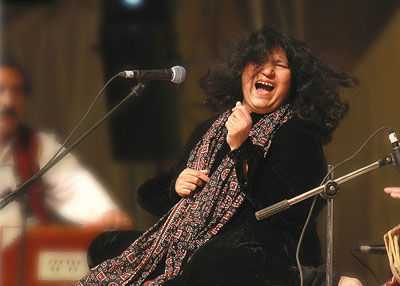
Abida Parveen
Another popular genre of Sufi music is qawwali, the most important and widespread in the Khusrau tradition, which has remained alive for more than seven centuries.
Sufi poetry has a special place in Pakistan’s national music, which has helped in promoting the message of Sufis in every age. From humble street-singers to renowned singers like the Waddali Brothers, Sain Zahoor, Abida Parveen and Pathanay Khan, and rock band Junoon have integrated Sufi poetry in their music. In the 1990s Junoon, rendered "Bullah Ki Jaana" and "Aleph" ("Ilmon Bas Kareen O Yaar").

The Wadali Bandhu, a Punjabi Sufi group from India, has also released a version of "Bullah Ki Jaana" on their album “Aa Mil Yaar... Call of the Beloved”. Another version was performed by Lakhwinder Wadali and entitled Bullah. In 2004, Rabbi Shergil turned the mysterious poem "Bullah Ki Jaana" into a Rock/Fusion song that became popular in India and Pakistan.

Bulleh Shah's verses have also been adapted and used in Bollywood film songs including "Chaiyya Chaiyya" and "Thayya Thayya" in the 1998 film “Dil Se”. While in 2007 the Pakistani movie “Khuda Kay Liye” includes Bulleh Shah's poetry in the song "Bandeya".

Recently three documentaries focusing on the lives of three eminent Sufi poets Shah Hussain, Bulleh Shah and Mian Muhammad Bukhsh who are truly known as the envoys of peace were screened in Islamabad, the capital of Pakistan. The purpose of the production of the documentaries is to promote the Sufi Poets’ message of humanity, love and peace in the society and to portray the Pakistani nation as a peace-loving nation.

Rabbi Shergil
After glancing back into the glorious past of Sufism, it becomes evident that Sufism is not something of forgotten past; in fact the message of tolerance, love, brotherhood – which is the message of the Sufis, can help cure a society shrouded with the disease of chaos and conflicts. As the devotion of the people at the shrines of Sufi saints proves that the saints of the Sub-continent are held in great esteem by the common people.

It is the need of the time to disseminate the traditional and original message of peace and harmony through the latest media of film and music to help unite the people of Pakistan and India who share common history, culture and heritage. The message of truth if resounded through different media of film and music can bring peace in the sub-continent and happiness to the frenzied lives of the people of the 21st century.


The message of Sufi saints, the envoys of peace which helped the people of different faiths come under the umbrella of humanity, of commonality in the subcontinent many years ago can certainly facilitate us to create a society based on love and spirituality beyond the barriers of caste, creed and religion.